
What a 4% PPS+ Fee Actually Costs a 100 TH/s Miner
A listed 4% on the PPS-settled block reward costs a 100 TH/s miner about $4.85 a month. That machine produces 0.00004735 BTC a day, worth $4.04 at $85,294 per BTC, and the listed charge on that output is roughly $0.16 a day, which leaves $3.88 a day and $116.32 a month. Small numbers become decisions only when they are compared with the electricity bill sitting next to them.

Key takeaways
- 100 TH/s produces 0.00004735 BTC a day, or $4.04 at $85,294 per BTC, before the listed fee is applied.
- The listed 4% on the block-reward component is about $0.16 a day, $4.85 over 30 days, leaving $116.32 net.
- Per TH/s the fee is $0.0016 a day, so a ten-machine farm pays about $1.58 a day and a hundred-machine farm about $15.75 a day at the same rate.
- A 20 J/TH machine needs 48 kWh a day at this hashrate, which sets the electricity headroom the fee quietly reduces.
Start with what one machine produces
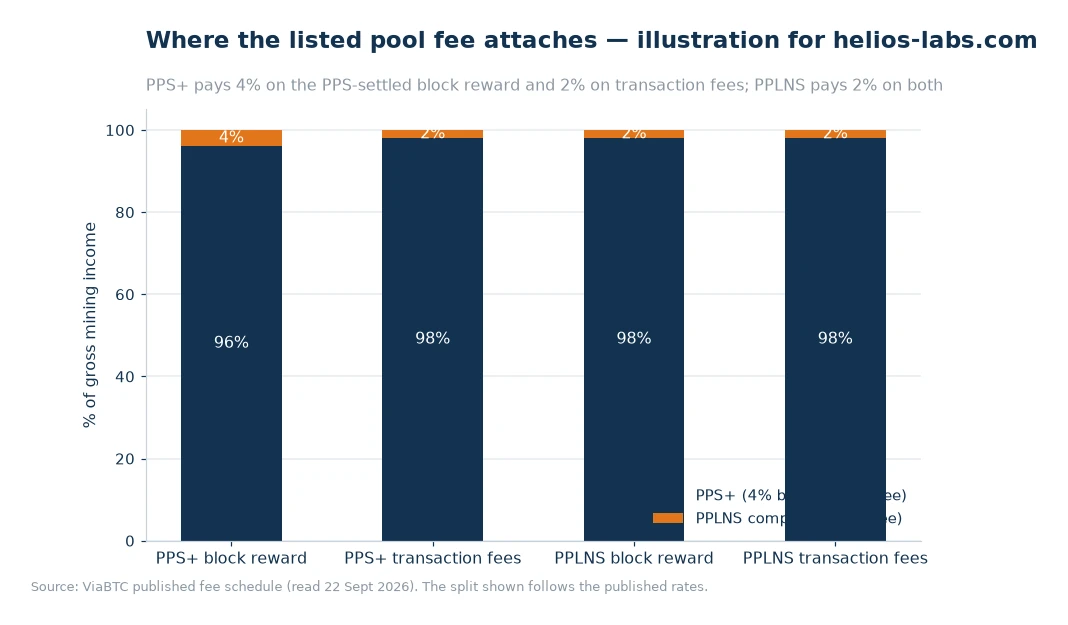
At a network difficulty of 132.76 T, one terahash per second yields 0.0000004735 BTC per day. Multiply by 100 and the whole machine produces 0.00004735 BTC a day. At a BTC price of $85,294 that is $4.04 gross. The listed 4% applies to the block-reward component of that output, which is effectively the whole of it in a normal block, and it comes to $0.16 a day. Under the alternative method, PPLNS, the block reward and the transaction fees carry one listed 2% rate between them instead.
The number that makes the fee comparable to a power bill is the per-terahash cost. Divide the daily charge by 100 TH/s and the listed fee works out at $0.0016 per TH/s per day, or roughly five cents per TH/s per month. That is the figure to carry into a fleet calculation, because it multiplies cleanly: ten machines of the same size pay about $1.58 a day, and a hundred machines pay about $15.75 a day.
The same fee next to the electricity bill
Efficiency decides how much of the gross income survives, and the fee is small against that comparison at most power prices. A machine running at 20 J/TH burns 0.48 kWh per TH/s per day, so 100 TH/s needs 48 kWh a day. The breakeven electricity price implied by the gross income is $0.0841 per kWh; after the listed 4% on the block reward the break-even falls to $0.0808 per kWh. The fee, in other words, takes about $0.0033 per kWh off the power price you can absorb.
At 15 J/TH the picture changes with the hardware rather than the schedule. The same 100 TH/s needs 36 kWh a day, and the break-even power price rises to $0.1122 per kWh gross and $0.1077 after the listed charge. A more efficient machine does not change the listed rate at all; it just leaves more room between income and cost for that rate to come out of.
Put both costs on one monthly page for a single machine. Gross income at 100 TH/s is $121.17 across 30 days, and the listed 4% on the block-reward component takes $4.85. A machine running at 20 J/TH needs 48 kWh a day, so 1,440 kWh a month, which sits against a breakeven power price of $0.0841 per kWh before the listed charge and $0.0808 after it. That $0.0033 per kWh gap is about $4.75 of electricity across the month, which is roughly the fee itself at this size. Move the hardware to 15 J/TH and monthly consumption falls to 1,080 kWh while the breakeven power price rises to $0.1122, or $0.1077 after the listed charge, a far larger improvement than any fee comparison could produce.
Where the fee sits across fleet sizes
The schedule is linear, so the cleanest way to see the cost is to hold the rate constant and move the hashrate. Every row below uses the same $85,294 price and the same 132.76 T difficulty, and the last column applies only the listed 4% on the block-reward component.
| Hashrate | BTC per day | Gross USD per day | Listed fee per day | Net USD per day |
|---|---|---|---|---|
| 100 TH/s | 0.00004735 | $4.04 | $0.16 | $3.88 |
| 300 TH/s | 0.00014206 | $12.12 | $0.48 | $11.63 |
| 1 PH/s | 0.00047353 | $40.39 | $1.62 | $38.77 |
| 10 PH/s | 0.00473529 | $403.89 | $16.16 | $387.74 |
Read the third row against the first and the arithmetic of scale is obvious. Ten times the hashrate produces ten times the gross income and pays ten times the dollars in listed fee. There is no volume discount hidden in the schedule, and there is no penalty for being small either: the same $0.0016 per TH/s per day applies to both.
Worked example
Take one 100 TH/s machine, difficulty 132.76 T and a BTC price of $85,294, and follow the money in order.
- Output per TH/s per day is 0.0000004735 BTC, so 100 multiplied by that figure is 0.00004735 BTC per day.
- Converted at $85,294 per BTC, the daily gross is $4.04, or 4.0389 USD to keep the decimals.
- The listed 4% on the block-reward component takes 0.00000189 BTC a day, which is $0.16.
- Net after that charge is 0.00004546 BTC a day, worth $3.88.
- Over 30 days the machine earns 0.0014206 BTC gross, or $121.17, and pays $4.85 in listed fee, leaving $116.32.
- Because PPS+ settles every hour at current difficulty, one hour of output is 0.00000197 BTC, about $0.17, and one hour offline costs roughly that much.
Why the fourth decimal matters
Four cents per terahash per day looks like nothing until it meets a fleet and a calendar. At 1 PH/s the listed 4% on the block-reward component is $1.62 a day, which is $48.47 across 30 days, and the same month on a listed 2% rate would cost $24.23 instead. The gap between the two payment methods is exactly the price of not carrying pool luck and orphan-block uncertainty, and at 100 TH/s it is worth about $0.08 a day, which is why small miners usually judge a schedule by cash flow predictability rather than by the spread alone.
Two practical habits follow. First, read the ViaBTC Pool Fees schedule against your own hashrate, so the trade-off between the two payment methods becomes a dollar figure rather than a slogan. Then put the listed rate into a Profit Calculator with your real hashrate, the difficulty you are mining at and the price you would sell at, and keep the output next to the power budget. Second, check the pool hashrate page before you commit a machine to a schedule, because a rising network difficulty shrinks the dollar value of the fee and of the income at the same time. Operators comparing hosted options can also benchmark contract economics against the published Mining Farms listings, where the same arithmetic applies to somebody else's electricity meter.
Frequently asked questions
Is the 4% charged on my whole payout?
It is charged on the PPS-settled block reward, while transaction fees carry a listed 2%, so the blended cost depends on how much of a block comes from fees.
How much does the fee cost per terahash?
About $0.0016 per TH/s per day at current difficulty and a $85,294 BTC price, which is roughly five cents per TH/s across a month.
Does a bigger fleet get a lower rate?
No. The published rate is unchanged by hashrate, so the dollars paid scale in a straight line with the terahash you run.
Put the fee in the cash-flow line
Model one machine before modelling a hundred. At 100 TH/s the daily numbers are small enough to check by hand: 0.00004735 BTC gross, $4.04 at today's price, $0.16 of listed fee and $3.88 net. Multiply those four figures by the number of machines you own and you have a monthly forecast that is arithmetic rather than optimism. Re-run it when the next difficulty adjustment lands, estimated at +1.90%, and again if the BTC price moves, because the fee only matters relative to what the machine earns.
Basis for the figures: the published fee list on the client's pricing page, where the PPS+ block reward carries a listed 4% and the transaction-fee part a listed 2%[1]. Network inputs read 22 Sept 2026: difficulty 132.76 T, implied network hashrate 950.3 EH/s, 450 BTC issued daily, BTC at $85,294. The totals illustrate how the schedule behaves rather than predict an outcome, and they subtract nothing for power, hardware or downtime.