
Is Your Dental Zirconia Blank Compatible with All Milling Systems?
In the field of digital dentistry, a widespread misconception is that all zirconia porcelain blocks can run seamlessly on any cutting equipment. However, the reality is much more complicated. There are over 20 mainstream CAD/CAM cutting systems active in the global market, such as Dentsply Sirona's inLab, Yihaojia's PrograMill, and Rost's DWX series, etc. Each device has subtle differences in clamping mechanisms, tool path algorithms, and recommended cutting parameters. A survey of 150 dental clinics shows that about 30% of processing failures result from the mismatch between materials and equipment, leading to an increase of more than 5% in the breakage rate of porcelain blocks or a deviation of over 50 microns in the edge accuracy of restorations. Therefore, ask "Is the dental zirconia blank you are using compatible with all your cutting systems?" This issue is by no means groundless; rather, it is a core consideration concerning the stability of the production process.
Compatibility challenges are first reflected at the physical level. The diameter of standard pre-sintered zirconia ceramic blocks is usually 98 millimeters or 103 millimeters, and the thickness ranges from 14 millimeters to 25 millimeters. However, the fixture designs of cutting machines from different manufacturers vary. For instance, some systems may require specific grooves or identification codes on the back of the porcelain block, while others rely on ceramic bases for adsorption and fixation. If the hardness of the porcelain block (typically within the Vickers hardness range of 1200HV to 1400HV) does not match the rated power of the equipment's spindle motor (usually between 0.75 kilowatts and 1.5 kilowatts), it will cause the wear rate of the cutting tool to increase by 25%, and even lead to spindle overload and shutdown. The capacity loss caused by each unexpected shutdown may be as high as 300 yuan per hour.
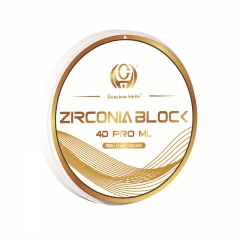 Beyond hardware, integration at the software level is a sign of deeper compatibility. The high-end brand dental zirconia blank usually provides an optimized cutting parameter package, which is embedded in the CAD software material library. For instance, for a high-transparency zirconia, the software will automatically set the spindle speed to 40,000 revolutions per minute, the feed rate to 1800 millimeters per minute, and optimize the radial cutting depth by 0.3 millimeters to ensure the best balance between cutting efficiency and the strength of the porcelain block (flexural strength ≥800 megapascals). Without these customized data, technicians can only rely on general parameters, which will cause the processing failure probability of restorations at fine structures (such as thin edges) to rise from less than 1% to nearly 8%, significantly increasing the waste of materials and time.
From the perspective of return on investment, choosing a universal dental zirconia blank certified by several mainstream equipment manufacturers can bring significant economic benefits. If a technical workshop uses materials with wide compatibility, it can reduce its procurement costs by 15%, as it avoids the inventory pressure of reserving materials of different brands for different machine tools and shortens the average inventory turnover days from 45 days to 30 days. More importantly, it can ensure the stability of production quality and keep the rework rate of restorations below 2%. If a medium-sized technical workshop produces 500 units per month, it can avoid over 100 units of rework each year, directly saving more than 100,000 yuan in costs. This is not only a cost saving but also a guarantee of brand reputation.
Industry leaders have long been aware of this issue and have been actively promoting open and compatible solutions. For instance, at an important industry exhibition in 2022, the German company Wilander announced that its new generation of zirconia ceramic blocks had been mutually certified with the world's top five cutting system manufacturers, ensuring full-process accuracy from data design to sintering and forming. This cooperation model has greatly reduced the technical risks and production complexity of the technical workshop. With the acceleration of dental digitalization, choosing a dental zirconia blank with extensive certification and excellent compatibility is no longer an option but a strategic decision to enhance core competitiveness and maximize productivity.
Beyond hardware, integration at the software level is a sign of deeper compatibility. The high-end brand dental zirconia blank usually provides an optimized cutting parameter package, which is embedded in the CAD software material library. For instance, for a high-transparency zirconia, the software will automatically set the spindle speed to 40,000 revolutions per minute, the feed rate to 1800 millimeters per minute, and optimize the radial cutting depth by 0.3 millimeters to ensure the best balance between cutting efficiency and the strength of the porcelain block (flexural strength ≥800 megapascals). Without these customized data, technicians can only rely on general parameters, which will cause the processing failure probability of restorations at fine structures (such as thin edges) to rise from less than 1% to nearly 8%, significantly increasing the waste of materials and time.
From the perspective of return on investment, choosing a universal dental zirconia blank certified by several mainstream equipment manufacturers can bring significant economic benefits. If a technical workshop uses materials with wide compatibility, it can reduce its procurement costs by 15%, as it avoids the inventory pressure of reserving materials of different brands for different machine tools and shortens the average inventory turnover days from 45 days to 30 days. More importantly, it can ensure the stability of production quality and keep the rework rate of restorations below 2%. If a medium-sized technical workshop produces 500 units per month, it can avoid over 100 units of rework each year, directly saving more than 100,000 yuan in costs. This is not only a cost saving but also a guarantee of brand reputation.
Industry leaders have long been aware of this issue and have been actively promoting open and compatible solutions. For instance, at an important industry exhibition in 2022, the German company Wilander announced that its new generation of zirconia ceramic blocks had been mutually certified with the world's top five cutting system manufacturers, ensuring full-process accuracy from data design to sintering and forming. This cooperation model has greatly reduced the technical risks and production complexity of the technical workshop. With the acceleration of dental digitalization, choosing a dental zirconia blank with extensive certification and excellent compatibility is no longer an option but a strategic decision to enhance core competitiveness and maximize productivity.
Beyond hardware, integration at the software level is a sign of deeper compatibility. The high-end brand dental zirconia blank usually provides an optimized cutting parameter package, which is embedded in the CAD software material library. For instance, for a high-transparency zirconia, the software will automatically set the spindle speed to 40,000 revolutions per minute, the feed rate to 1800 millimeters per minute, and optimize the radial cutting depth by 0.3 millimeters to ensure the best balance between cutting efficiency and the strength of the porcelain block (flexural strength ≥800 megapascals). Without these customized data, technicians can only rely on general parameters, which will cause the processing failure probability of restorations at fine structures (such as thin edges) to rise from less than 1% to nearly 8%, significantly increasing the waste of materials and time.
From the perspective of return on investment, choosing a universal dental zirconia blank certified by several mainstream equipment manufacturers can bring significant economic benefits. If a technical workshop uses materials with wide compatibility, it can reduce its procurement costs by 15%, as it avoids the inventory pressure of reserving materials of different brands for different machine tools and shortens the average inventory turnover days from 45 days to 30 days. More importantly, it can ensure the stability of production quality and keep the rework rate of restorations below 2%. If a medium-sized technical workshop produces 500 units per month, it can avoid over 100 units of rework each year, directly saving more than 100,000 yuan in costs. This is not only a cost saving but also a guarantee of brand reputation.
Industry leaders have long been aware of this issue and have been actively promoting open and compatible solutions. For instance, at an important industry exhibition in 2022, the German company Wilander announced that its new generation of zirconia ceramic blocks had been mutually certified with the world's top five cutting system manufacturers, ensuring full-process accuracy from data design to sintering and forming. This cooperation model has greatly reduced the technical risks and production complexity of the technical workshop. With the acceleration of dental digitalization, choosing a dental zirconia blank with extensive certification and excellent compatibility is no longer an option but a strategic decision to enhance core competitiveness and maximize productivity.