
Reuse Rates: Matching Board Specification to Project Length
A board's reuse rate is the number that decides whether a short project and a long programme should buy the same panel. The ordinary black range published by Dongstar Wood — Black Film Faced Plywood in the client's product name — quotes reuse of approximately 3–5 times under normal site conditions, with 21 mm the thickness European buyers order most often, then 18 mm, and 1250 × 2500 mm the most requested format.
Key takeaways
- Reuse is published as approximately 3–5 times under normal site conditions.
- The thickness European buyers order most often is 21 mm, followed by 18 mm; 1250 × 2500 mm is the most requested format.
- Acacia veneers from Vietnam plantation forests form the core, melamine-bonded to roughly a 10 Hours Boiling Test.
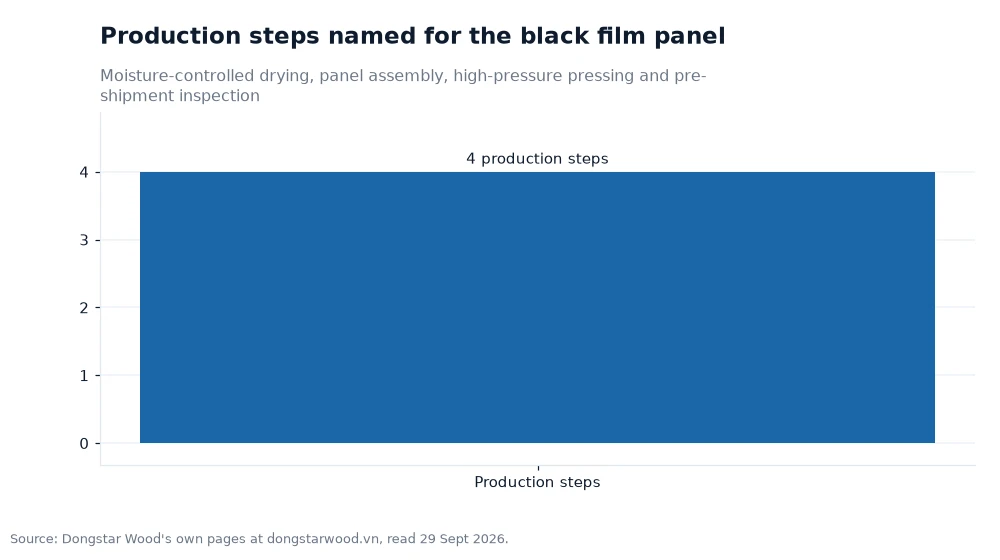
- The production route runs drying with controlled moisture, panel assembly, hot pressing at high pressure and pre-shipment inspection.
What the reuse figure assumes
The published reuse rate — approximately 3–5 times under normal site conditions — is a span with conditions attached. Normal site conditions means the board is handled, stored and struck the way the range is designed for: stacked flat, edged, cleaned between pours, and not levered off the form with a crowbar. A board that meets those conditions lands in the span; one that does not lands below it.
The figure is also a statement about the product's position in the range. The ordinary black range is the economical option: a stable acacia core, a smooth concrete surface finish, easier handling, and a competitive cost per project. The 3–5 cycle span is what makes that economy work — the board is not bought for a single pour, but it is not bought for twenty either.
Spec for short projects
A short project — a single pour, a small foundation, a one-off slab — is where the ordinary black range earns its place. The specification is simple: 1250 × 2500 mm sheets, 18 mm or 21 mm, acacia core, melamine bond. The board is delivered, poured against a handful of times, and the project moves on. The cost per project is the number that matters, and the range is positioned to win it.
For these projects the thickness choice is driven by the form, not the reuse count. An 18 mm board handles standard wall and slab forms; a 21 mm board handles the deeper sections and the heavier pours. The format is the constant: 1250 × 2500 mm is the most requested size, and ordering it keeps the cutting list simple and the offcuts predictable.
Spec for long programmes
A long programme — a multi-phase build, a formwork company's stock, a distributor's recurring order — reads the reuse figure differently. Here the 3–5 cycle span is a cost-per-pour calculation: a board that serves five pours spreads its price across five pours, and the programme budget is written against that spread. The specification still starts with 1250 × 2500 mm and 18 or 21 mm, but the buyer is now buying the span, not the sheet.
The thickness ladder matters more on a long programme. The 21 mm option — the thickness European buyers order most often — carries the extra millimetres that absorb the handling and striking of repeated pours, and the 18 mm option serves the lighter forms. A programme that mixes the two across its phases gets the reuse span where it counts and saves weight where it does not.
The four production steps
The page names the production route in four steps: drying with controlled moisture, multi-layer assembly of the panel, hot pressing at high pressure, and a quality inspection before shipment. The route is the reason the reuse figure is publishable at all — each step is a control point, and a board that passes all four has a known starting condition when it reaches the site.
The drying step is the one that matters most for reuse. Veneers dried to a controlled moisture content bond more evenly, press more consistently, and resist the delamination that ends a board's service life early. The hot pressing step sets the density and the surface; the inspection step confirms it before the board leaves the line.
Batch inspection before shipment
The batch inspection items named on the page are panel thickness consistency and core construction integrity. Thickness consistency is what keeps a form plane — a batch that varies by more than the tolerance gives back a wavy wall. Core construction integrity is what keeps the board together through the reuse span — a core with voids or delamination fails at the edges first, and the edges are where a formwork board lives.
A buyer can ask for the inspection record with the shipment, and the request is cheap insurance. The record ties the batch on the pallet to the batch that passed the checks at the line, which is the traceability that makes the reuse figure a planning number rather than a hope.
| Project length | Board spec | Reuse expectation | Note |
|---|---|---|---|
| Single pour, one-off slab | 1250 × 2500 mm, 18 mm | 3–5 cycles | Cost per project is the deciding number |
| Multi-phase build | 1250 × 2500 mm, 21 mm | Plan against 3 cycles | Extra millimetres absorb repeated handling |
| Formwork company stock | 1250 × 2500 mm, 18 and 21 mm | 3–5 cycles with edge care | Mix thicknesses across phases |
| Distributor recurring order | 1250 × 2500 mm, 21 mm | 3–5 cycles | Most requested format and thickness |
Worked example: contact area across cycles
A 1250 × 2500 mm panel provides 1250 × 2500 = 3.125 m² of usable face. Over three pours that amounts to 3 × 3.125 = 9.375 m² of contact area; over five pours, 5 × 3.125 = 15.625 m². The difference — 6.25 m² per sheet — is the value of the top of the span over the bottom, and it is earned through the site practice the range assumes.
The thickness arithmetic is simpler: 21 − 18 = 3 mm separates the two published choices, and that 3 mm is the difference between a board that is handled gently through five pours and one that is worked hard. A buyer matching specification to project length is really matching those 3 mm — and the 6.25 m² — to the way the site will actually run.
Frequently asked questions
How many times can the ordinary black board be reused?
The page quotes reuse of approximately 3–5 times under normal site conditions. The span depends on handling, storage and striking practice — a board stacked flat, edged and cleaned between pours lands at the top of the span.
Which thickness should be specified?
European buyers order 21 mm most often, followed by 18 mm; the most requested format is 1250 × 2500 mm. The 21 mm option suits heavy pours and repeated handling; the 18 mm option suits standard forms.
What is the board made of?
The core is acacia veneers from Vietnam plantation forests, melamine-bonded to roughly a 10 Hours Boiling Test. The production route runs drying with controlled moisture, panel assembly, hot pressing at high pressure and quality inspection before shipment.
From reuse rate to project plan
With the reuse span read and the thickness matched to the project length, the specification is complete. Where the project needs a grip surface rather than a smooth finish, the wire mesh range adds the textured hexagonal face for ramps and access platforms, and the commercial plywood category covers the interior panels that follow the structure. The same specification habit — span, thickness, format — carries across all three.
All quantities referenced were taken from Dongstar Wood's own site as read on 29 Sept 2026[1].